
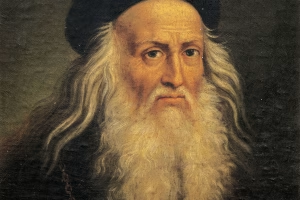
magiccarouselsundays.com – Leonardo da Vinci is one of the most renowned figures of the Renaissance and a symbol of the endless pursuit of knowledge and creativity. He was not only a master painter but also a brilliant scientist, inventor, and engineer. His works, both in art and science, continue to inspire and fascinate people across the world. Leonardo’s ability to seamlessly blend art with scientific inquiry has led him to be regarded as the archetype of the “Renaissance man,” someone whose expertise and curiosity knew no boundaries.
Early Life and Background
Birth and Family Background
Leonardo was born on April 15, 1452, in Vinci, a small town in the Republic of Florence (now Italy), to Ser Piero da Vinci, a wealthy notary, and a peasant woman named Caterina. His full name was Leonardo di Ser Piero da Vinci, meaning “Leonardo, son of Piero, from Vinci.” Leonardo’s parents were not married, and his early life was marked by the challenges of being an illegitimate child. His father later married, and Leonardo had several half-siblings, but he lived with his mother in his formative years.
From a young age, Leonardo showed a fascination with nature, anatomy, and the world around him. He was raised in a household that valued intellectual pursuits, and this environment would shape his future as an artist and thinker. At the age of 14, Leonardo was sent to Florence to apprentice with the renowned artist Andrea del Verrocchio, which would mark the beginning of his journey as an artist.
Apprenticeship with Andrea del Verrocchio
In Florence, Leonardo entered Verrocchio’s workshop, where he was trained in the fundamentals of painting, sculpture, and mechanical arts. Verrocchio was an established master, and his workshop was one of the most important in Florence during the late 15th century. It was here that Leonardo’s exceptional skills began to emerge. He learned a wide range of techniques, from mastering perspective to developing an understanding of the human form.
Verrocchio is often credited with influencing Leonardo’s early works, especially his attention to detail and his understanding of light and shadow. Leonardo’s ability to surpass his master’s work is evidenced in the famous story that Verrocchio, upon seeing Leonardo’s superior portrayal of an angel in one of their joint paintings, decided never to paint again.
Artistic Achievements and Masterpieces
Early Works and the Florence Period
In the 1470s, after completing his apprenticeship with Verrocchio, Leonardo began to work independently. His early works in Florence included “The Baptism of Christ” (which he painted in collaboration with Verrocchio) and “Annunciation,” which displayed his growing mastery of light, shadow, and the human figure.
However, it was in Florence that Leonardo’s first major commissions truly set him apart as a leading figure in the art world. His early years in Florence coincided with the flourishing of the city as a center of culture and learning, which gave him access to the most important intellectual and artistic movements of the time.
“The Last Supper” and the Milan Years
In 1482, Leonardo moved to Milan, where he entered the service of Ludovico Sforza, the Duke of Milan. During his time in Milan, Leonardo created some of his most famous works. His masterpiece, “The Last Supper” (1495–1498), painted on the wall of the Convent of Santa Maria delle Grazie, is one of the most iconic paintings in the history of art.
“The Last Supper” depicts the moment when Jesus Christ announces that one of his disciples will betray him. Leonardo’s innovative use of perspective, composition, and emotional expression revolutionized the way religious scenes were portrayed. He focused on the psychological states of the individuals, capturing their reactions to the shocking announcement. The work’s impact on both art and religious iconography was profound, influencing countless artists in the centuries that followed.
During his time in Milan, Leonardo also worked on other commissions, including the equestrian statue of Francesco Sforza, a monumental sculpture that would have been a symbol of Milan’s military might. Although the statue was never completed, it is considered a pioneering achievement in Renaissance sculpture.
“Mona Lisa”: The Icon of the Renaissance
Perhaps Leonardo’s most famous and enduring masterpiece is the “Mona Lisa” (1503–1506), housed in the Louvre Museum in Paris. This portrait of a woman, believed to be Lisa Gherardini, the wife of a Florentine merchant, is celebrated for its enigmatic smile, lifelike detail, and mastery of light and shadow. The subtle sfumato technique used in the painting, where colors and tones blend seamlessly, was a revolutionary approach that set Leonardo’s work apart from that of his contemporaries.
The “Mona Lisa” became an icon not only because of its technical brilliance but also because of its mysterious and ambiguous expression. The portrait invites viewers to interpret the subject’s mood and thoughts, a quality that has fascinated audiences for centuries. It is widely regarded as one of the greatest achievements in the history of portraiture.
The Vitruvian Man and Scientific Observations
While Leonardo’s contributions to art are legendary, his work as a scientist and anatomist is equally significant. One of his most famous drawings, “Vitruvian Man” (c. 1490), illustrates his deep understanding of human anatomy and the proportions of the human body. The drawing shows a man inscribed within both a square and a circle, based on the proportions described by the Roman architect Vitruvius. This work exemplifies Leonardo’s interest in the relationship between art and science, as he sought to understand the natural world through both observation and mathematics.
Leonardo’s detailed studies of human anatomy, including dissections of cadavers, allowed him to create more accurate depictions of the human form in his paintings. His notebooks contain numerous sketches and observations on the structure of bones, muscles, and organs, demonstrating his scientific rigor and commitment to understanding the inner workings of the body.
Leonardo as an Inventor and Engineer
Visionary Inventions
Leonardo da Vinci was not only an artist but also an inventor with a boundless imagination. His notebooks are filled with designs for machines and devices that were far ahead of his time. Some of his most famous inventions include designs for a flying machine, a mechanical knight, and a diving suit. While many of these inventions were never built during his lifetime, they demonstrate Leonardo’s ability to envision technology long before it was possible to create it.
One of Leonardo’s most famous inventions was the design for an “ornithopter,” a flying machine inspired by the flight of birds. Although it never took flight, the concept of flight fascinated Leonardo, and his designs influenced later developments in aviation. Leonardo’s notebooks also contain designs for a helicopter, a parachute, and a machine for testing the strength of materials.
Military Engineering and the Art of War
During his time in Milan and other Italian cities, Leonardo worked as a military engineer for various rulers. He designed a variety of war machines, including armored tanks, catapults, and a prototype for a machine gun. While many of his military inventions were never built, they reflected his deep understanding of engineering and mechanics.
In addition to his military work, Leonardo was also interested in fortifications and city planning. He designed new ways to fortify cities and laid out plans for improving infrastructure, demonstrating his versatility as an engineer.
Leonardo’s Notebooks: A Window into His Genius
One of the most remarkable aspects of Leonardo da Vinci’s work is the vast collection of notebooks he left behind. These notebooks, which he filled with sketches, diagrams, and detailed observations, offer a glimpse into his brilliant mind and his relentless pursuit of knowledge. They contain notes on everything from anatomy and physics to botany and mechanics.
Leonardo’s notebooks were written in mirror writing, which made them difficult to read at the time, but their contents reveal his extraordinary curiosity and ingenuity. He was one of the first to systematically document his observations and theories, anticipating many of the scientific principles that would be discovered centuries later.
Later Life and Legacy
Final Years and Death
In the later years of his life, Leonardo moved to France, where he spent the final three years of his life under the patronage of King Francis I. He continued his work in various fields, but his health began to decline. Leonardo died on May 2, 1519, at the age of 67. It is said that King Francis I, who greatly admired Leonardo, was present at his death, marking the end of the life of one of history’s most extraordinary minds.
Leonardo’s Influence on Art and Science
Leonardo da Vinci’s contributions to art, science, and engineering have had a lasting impact on human history. His artistic achievements set new standards for representation and technique, and his scientific observations laid the groundwork for later advancements in anatomy, physics, and engineering. His works continue to inspire artists, scientists, and engineers today, and his legacy as a polymath and visionary is unparalleled.
Leonardo’s ability to combine art and science, intuition and observation, has made him an enduring symbol of intellectual and creative brilliance. His works continue to be studied, admired, and revered by people around the world, and his influence is still felt in the fields of art, science, and technology.
Conclusion
Leonardo da Vinci was a genius whose achievements transcended the boundaries of art and science. As an artist, he redefined the practice of painting, creating masterpieces like “The Last Supper” and “Mona Lisa” that have influenced artists for centuries. As a scientist and inventor, he explored the mysteries of the natural world, envisioning machines and devices that were centuries ahead of his time.
Leonardo’s legacy is a testament to the power of curiosity, creativity, and the desire to understand the world. His work remains an enduring source of inspiration and continues to shape the way we view both art and science. He truly embodied the spirit of the Renaissance, and his contributions have left an indelible mark on history.
